Here is some basic info about each spice :
(for more info or quick tips and spice mix know-how, click on the Herb topic link)
Allspice
Ground allspice is not, as some people believe, a mixture of spices. Rather, it is the dried fruit of the Pimenta dioica plant. It is especially used as a seasoning for meats, soups, and deserts. Allspice contains quercetin, a nutrient that helps to prevent allergies. Allspice also helps to provide relief from indigestion and flatulence.
Anise
Anise is an annual plant with a strong licorice flavor. It is used as a seasoning to compliment both sweet and savory foods such as cakes, biscuits, seafood and poultry. Anise contains medicinal properties that help to relieve congestion from allergies, colds, and flu. It has also been used to treat digestive problems and to help relieve menstrual cramps.
Caution: Allergies are possible, but rare. Not recommended while pregnant or nursing.
Arrowroot Starch
Arrowroot powder is the edible starch that comes from the rhizomes (rootstock) of the arrowroot plant. It is used as a thickening agent in many foods such as puddings, sauces, gravies, jellies, fruit pies, and biscuits. Due to its great digestibility compounds arrowroot starch is used as a primary ingredient in infant cookies instead of wheat flour. The starch helps to soothe digestive conditions such as irritable bowel syndrome.
Basil
Basil is a tender low-growing herb that is prominently featured in Italian and Southeast Asian cuisine. It is commonly used fresh in cooked recipes, and added at the last moment because cooking quickly destroys its flavor. There are several varieties of basil including sweet basil, Thai basil, lemon basil, and holy basil. Basil is currently being studied due to its possible health benefits for alleviating conditions such as digestive problems, cancer, diabetes, high cholesterol, arthritis, and several others.
Caution: The safety of the herb has not been established for pregnant women, nursing mothers, or children under six.
Bay Leaves
Bay leaves are the aromatic leaves of the Bay Laurel Shrub. Fresh or dried bay leaves are often used to flavor soups, stews, braises and pâtés in Mediterranean Cuisine. Bayleaves have been used medicinally for lowering blood sugars and slowing weight gain.
Caution: Although bay leaves are safe to eat, they remain very stiff even after thorough cooking. Because of this, bay leaves are not considered culinarily acceptable. Eating whole bay leaves may also pose a risk of general injury to the throat. This is the reason why all recipes that use bay leaves will recommend their removal after the cooking process has finished.
Black Pepper
Black pepper comes from the dried fruit (peppercorns) of a flowering vine. It is used as a spice and seasoning in many cuisines around the world. When the peppercorns are ground into a powder it is referred to as black pepper, white pepper, red/pink pepper, green pepper, and very often simply pepper. Recent scientific investigations indicate that the piperine in black pepper acts as an antioxidant, a pain relief agent, and it might help to prevent the spread of cancer cells. Ground pepper is eliminated from the diet of patients having abdominal surgery and ulcers because of its irritating effect on the intestines.
Caution: Avoid excessive use of black pepper (more than 1 teaspoon per day) if you take prescription digoxin (Lanoxin) or phenytoin (Dilantin). Too much pepper may slow the rate at which the liver clears these medications from the bloodstream.
Caraway
The Caraway plant has been used for a variety of purposes dating all the way back to 3000 BC. Caraway seeds, also referred to as the fruit, are used to give a distinctive flavor to rye bread, cabbage, sauerkraut, sausage, cheese, and soups. It has been used as a remedy for menstrual cramps, gallbladder spasms, loss of appetite, digestive disorders, and to dispel worms.
Cardamom
There are two species of cardamom, Elettaria and Amomum, also known as green and black cardamom. They are both used as spices for foods and drinks. Cardamom helps to prevent flatulence and may also help to prevent Colon Cancer. Cardamom is especially used in cuisines such as pilafs, various rice dishes, meat and vegetable curries.
Cayenne
Cayenne peppers are members of the Capsicum family along with bell peppers, jalapeños, paprika, and pimento. The word cayenne usually refers to any type of hot ground chile pepper. Cayenne is actually from a specific type of chile pepper. To compare the relative heat of chile peppers, the Scoville scale assigns a number between 0 and 300,000 heat units. Each unit represents the amount of “hotness” a person would experience when consuming a chile or chile product. The higher the number, the hotter the pepper. Sweet bell peppers are rated 0 because you experience no heat when consuming them. On the other hand, cayenne pepper is rated at 30,000 -50,000Scoville units. Cayenne is used medicinally and also as a seasoning for spicy, hot dishes. It contains a pungent substance known as capsaicin, which is responsible for the burning hot sensation that people experience after eating the pepper. Cayenne pepper is used commonly as a thermogenic and to improve blood circulation and general circulatory health.
Caution: Don't touch your eyes with your hands after you have handled capsaicin cream. Excessive use internally may result in gastro-intestinal upset.
Celery Seed
Celery is used around the world as a vegetable, either for the crisp petiole (leaf stalk) orthe fleshy taproot. In temperate countries, celery is also grown for its seeds. Celery seeds can be used as flavoring or spice either as whole seeds or, ground and mixed with salt, as celery salt. Celery salt can also be made from an extract of the roots. Celery salt is sometimes used to season tomato and vegetable juices, meat roasts, and seafood. Seeds intended for cultivation are not suitable for eating as they are often treated with fungicides. Celery seed is a traditional remedy for nervous stomach and for relieving flatulence.
Caution: A few people have severe allergic reactions to celery. For people with celery allergy, exposure can cause potentially fatal anaphylactic shock.
Chervil
Chervil is a delicate annual herb related to parsley. It is used to season mild-flavored dishes. Sometimes referred to as "gourmet's parsley", chervil is used to season poultry, seafood, and vegetables. It is particularly popular in France, where it is added to omelettes, salads and soups. Chervil has been used medicinally as a blood purifier, a digestive aid, for lowering high blood pressure, and infused with vinegar it has been used as a cure for hiccups.
Caution: Safety not established during pregnancy or nursing or for children under the age of 6.
Chili Powder
Chili powder is a generic name for any powdered spice mix composed chiefly of chili peppers, usually either red peppers or cayenne peppers, which are both from the Capsicum family. The spice mix may simply be pure powdered chilies, or it may have other ingredients included such as cumin, oregano, garlic powder, and salt. Some mixes may even include black pepper, cinnamon, cloves, coriander, mace, nutmeg, or turmeric. As a result of the various different potential additives, the spiciness of any given chili powder is incredibly variable. As a rule, the purer the chili powder is, the spicier it is. Chili powder is regularly used in traditional Indian cuisine. Today it is especially popular in American cuisine, where it’s the primary flavor ingredient in chili con carne.
Caution: Don't touch your eyes with your hands after you have handled capsaicin cream. Excessive use internally may result in gastro-intestinal upset.
Chives
Chives are the smallest species of the onion family. They are a common household herb, frequent in gardens as well as in grocery stores. Chives can be added to foods such as fish, potatoes, omelets & scrambled eggs, and soups. Their insect-repelling properties make them valuable as a pest control in gardens. Chives help to lower blood pressure. They are also rich in vitamins A and C, and contain trace amounts of sulfur and iron. Since chives are usually served in small amounts and never as the main dish, negative effects are rarely encountered, although digestive problems may occur following over-consumption.
Cilantro
Cilantro is the leafy portion of the same plant that gives us coriander seed, but the two bear little resemblance to one another in terms of flavor characteristics. Cilantro resembles parsley in appearance, and is commonly called Chinese parsley or Japanese parsley. It is used as a seasoning in many foods around the world. It adds great flavor to chutneys & relishes, soups & stews, curry dishes, and stir-frys. Like many herbs, cilantro’s flavor diminishes with prolonged heat so add it to your dishes in the final five minutes of cooking. Cilantro is antimicrobial. It has also been used to settle upset stomach in Latin American herbal healing traditions.
Cinnamon
Cinnamon powder and sticks are derived from the bark of tropical evergreen trees. The name cinnamon is correctly used to refer to Ceylon cinnamon, also known as "true cinnamon". However, the related species, Cassia, Saigon Cinnamon, and Cinnamomum burmannii are sometimes sold labeled as cinnamon. There are two main varieties of the bark: Ceylon cinnamon and cassia. Cinnamon can be used as a flavoring agent for many foods including baked goods, squash & sweet potatoes, Indian curries, and beverages such as tea. Cinnamon has traditionally been used to treat toothache and fight bad breath. Its regular use is believed to help prevent the common cold and aid digestion. Cinnamon is high in antioxidant activity. The essential oil of cinnamon also has antimicrobial properties that can help to preserve certain foods.
Caution: It has been noted by the German Commission E that some people are in fact allergic to cinnamon, with side effects ranging from an allergic skin reactions to mucosa.It is not recommended for medicinal uses during pregnancy or breastfeeding.
Cloves
Cloves are the aromatic dried flower buds of a small evergreen tree that is native to the Molucca islands of Indonesia. Cloves have historically been used in Indian cuisine as well as Mexican cuisine. In north Indian cuisine, the spice is used in almost all dishes, along with other spices. It is also a key ingredient in tea along with green cardamom. Clovescan be added to many foods including pilafs, pumpkin pie, and various rice dishes.
Cloves have been used to alleviate pain, prevent and treat bacterial infections, settle upset stomach, ease toothaches, treat worms, and relieve congestion. Since cloves contain anesthetic and antiseptic properties, they are the active ingredient in many over the counter toothache remedies.
Caution: Large amounts should be avoided during pregnancy. Cloves can be irritating to the gastrointestinal tract, and should be avoided by people with gastric ulcers, colitis, or irritable bowel syndrome. In overdoses, cloves can cause vomiting, nausea, diarrhea, and upper gastrointestinal hemorrhage. People who have kidney or liver disorders and those with a history of seizures should avoid the use of cloves. Severe overuse can lead to kidney failure, changes in liver function, dyspnea, loss of consciousness, hallucination, and even death.
Coriander
Coriander is the seed of an annual herb in the family Apiaceae. The leaves are known as cilantro, particularly in America. All parts of the plant are edible, but the fresh leaves and the dried seeds are the most commonly used in cooking. Coriander is commonly used in Middle Eastern, Mediterranean, Indian, South Asian, Mexican, Latin American, Chinese, African and Southeast Asian cuisine. Ground Coriander is ideal for curries and spicy sauces. It can be added to other foods such as Asian salads, stir-fries, stews, and potatoes. In holistic and some traditional medicine, it is used as a carminative and for general digestive aid.
Caution: Coriander can produce an allergic reaction in some people.
Cumin
Cumin is the dried seed of a small plant in the parsley and carrot family. It is the second most popular spice in the world after black pepper. Cumin seeds are used as a spice for their distinctive aroma and pungent taste. Cumin powder is a popular ingredient in many cuisines from around the world. It can be added to curries, enchiladas, tacos, chili, and other Middle-Eastern, Indian, Cuban and Mexican-style foods. It is also commonly used in traditional Brazilian cuisine. Medicinally, cumin has been used as a diuretic and to treat stomach upset and flatulence. In herbal medicine, it is classified as being a stimulant, carminative, and antimicrobial.
Caution: Be forewarned that cumin stimulates the appetite and may increase lactation in nursing mothers.
Curry Powder
Curry powder is a spice mixture of widely varying composition. It is a classic of Indian cuisine. In the Western world, curry powder mixtures tend to have fairly standardized taste, whereas in its original India there are many different curry flavors available to be experienced for the true gourmet. Most curry powders contain coriander, turmeric, cumin, and fenugreek in their blends. Depending on the recipe, additional ingredients such as ginger, garlic, fennel seed, cinnamon, clove, mustard seed, green cardamom, black cardamom, mace, nutmeg, red pepper, long pepper, and black pepper may also be added. Curry powder can be added to several foods including meat and vegetable dishes, noodles, couscous, stir-fries, and marinades.
Dill
Dill weed isn’t a weed at all. It is actually a sturdy, delicate-looking annual that’s been cultivated as far back as 3,000 BC. Fresh and dried dill leaves (sometimes called "dill weed" to distinguish it from dill seed) are used as herbs. Dill seed is used as a spice, with a flavor somewhat similar to caraway, but also resembling that of fresh or dried dillweed. Dill weed’s flavor is mild and sweet, with slight hints of anise and parsley. Dill weed is said to be best when used fresh, because it looses it’s flavor rapidly if dried. If using dried dill weed, it is recommended that it be added towards the end of cooking or in recipes with low or no heat so that it retains its flavor and aroma. Dill can be added to many foods including potato salads, vegetable dips, salad dressings, fish and poultry dishes, and omelets. Both dill weed and dill seed help to settle upset stomach and are mildly antibacterial.
Fennel Seeds
Fennel is a highly aromatic and flavorful herb. It is generally considered indigenous to the shores of the Mediterranean, but has become widely naturalized elsewhere. It may now be found growing wild in many parts of the world, especially on dry soils near the sea-coast and on river-banks. Fennel can be added to many foods including soups, Italian sausages, pasta, salads, and tomato dishes. Fennel has been used to treat digestive problems such as stomach cramps, added to laxatives to ensure gentle action, used in teas to break up congestion caused by colds and allergies, and fennel seed tea is helpful in treating babies with colic (please see precautions).
Caution: Fennel seed teas are helpful for colicky infants, but fennel seed oil should never be given to infants or young children because of the danger of spasms of the throat.
Garlic
Garlic is a species in the onion family. Its close relatives include the onion, shallot, leek, and chive. Garlic cloves are used as seed for consumption (raw or cooked), and for medicinal purposes. The leaves, stems, and flowers are also edible and are most often consumed while immature and still tender. The papery, protective layers of "skin" over various parts of the plant and the roots attached to the bulb are the only parts not considered palatable. Garlic is widely used around the world for its pungent flavor as a seasoning or condiment. It can be added to many savory foods including curries, meats, potatoes, salad dressings, and gravies. Garlic is claimed to help prevent cancer and heart disease (including atherosclerosis, high cholesterol, and high blood pressure). Garlic is also being studied for its ability to help regulate blood sugar levels.
Ginger
Ginger is the underground stem (root) of the ginger plant. It is used as a spice and is also consumed whole as a delicacy or medicine. The juice from ginger roots is extremely potent and is often used as a spice in Indian recipes and Chinese cuisine to flavor dishes such as seafood or mutton and vegetarian recipes. Powdered dry ginger root (ginger powder) is typically used to spice gingerbread and other recipes. Ginger is also made into candy, is used as a flavoring for cookies, crackers and cake. It is the main flavor in ginger ale—a sweet, carbonated, non-alcoholic beverage. Ginger can also be added to winter squashes, carrots, teas, couscous, and spiced preserves. Studies have shown that ginger offers a wide range of medicinal actions including: lowering cholesterol levels, and relieving allergies, asthma, arthritis, colds, and nausea.
Marjoram
Marjoram (sometimes called sweet marjoram) is a perennial herb in the mint family. It provides the flavors of sweet pine and citrus. It is used for both culinary and medicinal purposes. Oregano is a close relative of marjoram and is sometimes called wild marjoram. Marjoram is milder and provides a more subtle, savory, and less peppery taste than oregano. Marjoram helps to prevent spasms in the digestive tract.
Caution: Women who experience heavy menstruation should avoid marjoram. The herb is not recommended for infants and small children.
Mint
Mint herb divides into two major groups, spearmint and peppermint. Spearmint is most often used for culinary purposes and peppermint is used for its medicinal properties and also to flavor sweets and breath fresheners. The leaves, fresh or dried, are the culinary source of mint. Fresh mint is usually preferred over dried mint when storage of the mint is not a problem. The leaves have a pleasant warm, fresh, aromatic, sweet flavor with a cool aftertaste. Mint leaves can be added to beverages, teas, jellies, roasted meats, syrups, candies, and ice creams. Mint was originally used as a medicinal herb to treat stomach ache and chest pains. It is commonly used in the form of tea as a home remedy to help alleviate stomach pain. Mint leaves are often used by many campers to
repel mosquitoes.
Mustard Seeds
Mustard seeds are the small seeds of the various mustard plants. There are three varieties of mustard: black, brown and white. The yellow in the common mustard condiment comes from the addition of tumeric. Although mustard seeds are some of the smallest of all seeds, the mustard plant can grow to a very large size. Ground mustard seeds are the recommended choice when dispersing the spice into foods. Whole mustard seeds can be boiled with vegetables or used in pickling. Mustard seed can be added to several foods including pickling spices, marinades, salad dressings, barbecue sauces, and roasted red meats. Mustard paste can be made by combining mustard seed powder with water/vinegar and some seasonings. It can be used as a condiment. Mustard is known to be very helpful for digestion, and can help to speed up the metabolism. Mustard seeds are a very good source of omega-3 fatty acids as well as calcium, dietary fiber, iron, manganese, magnesium, niacin, phosphorus, protein, selenium and zinc.
Nutmeg
Nutmeg is an evergreen tree indigenous to the Moluccas (The Spice Islands) of Indonesia. Two spices are derived from the fruit, nutmeg and mace. Nutmeg is the actual seed of the tree and mace is the dried "lacy" reddish covering of the seed. This is the only tropical fruit that is the source of two different spices. Nutmeg and mace have similar taste qualities, but nutmeg is slightly sweeter and mace has a more delicate flavor. Mace is often preferred in light dishes for the bright orange, saffron-like hue it imparts. Nutmeg adds a tasty addition to cheese sauces and is best when grated fresh. Nutmeg is a traditional ingredient in mulled cider, mulled wine, and eggnog. Nutmeg can be added to several foods including cookies & cakes, cooked squashes, milk & rice puddings, cheese dishes, and sauces. In herbal medicine nutmeg powder is used to relieve or prevent flatulence and to break up chest congestion.
Caution: Nutmeg is a very weak hallucinogen; caution and moderation should be
exercised.
Onion
Onion powder is a spice made from finely ground dehydrated onions. It is mainly made with the pungent varieties of bulb onions, which causes the powder to have a very strong smell. Onion powder comes in a few varieties: white onion powder, red onion powder, yellow onion powder, and toasted onion powder. Onions are an important ingredient in almost every culture’s cuisine. Onion powder combines well in sauces, soups and spice blends without adding unwanted texture. It can be added to many dishes including meatloaves, soups & sauces, casseroles, and vegetables. In traditional herbal medicine, onion is a gentle herb for relieving toxicity and breaking up “clumps” of infections (sores or abscesses). Onions can also be used to induce perspiration to ‘sweat out a cold,” and relieve nasal congestion. Onions can also help to relieve abdominal pain.
Caution: Onion powder is toxic to dogs. Also, avoid using this product when there is profuse sweating.
Oregano
Oregano is an aromatic, slightly bitter herb in the mint family. It is often used in tomato sauces, with fried vegetables, and with grilled meats. Together with basil, it contributes much to the distinctive character of many Italian dishes. Oregano combines well with pickled olives, capers, and lovage leaves. It also works well with hot and spicy food, which is popular in southern Italy. Oregano is a popular ingredient in Greek cuisine. It adds flavor to Greek salads and is usually used separately or added to the lemon-olive oil sauce that accompanies many fish or meat barbecues and some casseroles. Oregano can be added to many dishes including pasta sauces & pizzas, Italian & Mexican dishes, roasted vegetables, salsas, hearty soups & stews, and flavored oils &
vinegars. Oregano is high in antioxidant activity, due to a high content of phenolic acids and flavonoids. Additionally, oregano has demonstrated antimicrobial activity against food-borne pathogens such as Listeria monocytogenes. Both of these characteristics may be useful in both health and food preservation. In the Philippines, oregano is not commonly used for cooking but is rather considered as a medicinal plant, useful for relieving children's coughs.
Caution: Safety of use during pregnancy is unknown.
Paprika
Paprika is a spice made from the grinding of dried Capsicum (such as bell pepper). In many European countries, the word paprika also refers to bell peppers themselves. The seasoning is used in many cuisines to add color and flavor to dishes. Paprika flavors vary widely from country to country ranging from spicy to sweet. It is used as an ingredient in a broad variety of dishes throughout the world. Paprika is mainly used to season and add color to rice dishes, stews & soups, and meats. It is often smoked in order to draw out additional flavors. Paprika can be added to meat rubs, deviled eggs, Hungarian goulash, egg salad, and as a garnish for any casserole. Paprika is unusually rich in vitamin C and is also a good source of carotenoids. Capsicum peppers used for paprika contain six to nine times as much vitamin C as tomatoes by weight. High heat leaches the vitamins from peppers, thus commercially-dried peppers are not as nutritious as those that are sun-dried.
Parsley
Parsley is a bright green herb that is very common in Middle Eastern, European, and American cooking. Parsley is used for its leaf in much the same way as coriander (which is also known as Chinese parsley or cilantro). Parsley has a milder flavor than coriander. Two forms of parsley are used as herbs: curly leaf and Italian, or flat leaf. Curly leaf parsley is often used as a garnish. Parsley can be added to many foods including egg dishes, mashed potatoes, tabouleh & other salads, pastas, and vegetables. The most common use of parsley is as an edible breath freshener. Naturopathic practitioners often recommend fresh parsley as a detoxifier because of its concentrated chlorophyll.
Caution: Parsley should not be consumed as a drug or supplement by pregnant women. Parsley as an oil, root, leaf, or seed could lead to uterine stimulation and preterm labor. Also, parsley is high in oxalic acid, a compound involved in the formation of kidney stones and nutrient deficiencies.
Poppy Seeds
A poppy is any of a number of showy flowers, typically with one per stem, belonging to the poppy family. The seeds of the opium poppy are widely consumed in many parts of Central and Eastern Europe. The sugared, milled mature seeds are eaten with pasta, or they are boiled with milk and used as filling or topping on various kinds of sweet pastry. All parts of the poppy plant can contain or carry the opium alkaloids. Eating foods, such as muffins, that contain poppy seeds can result in a false positive for opiates in a drug test. The test is true positive in that it indicates the presence of the drug correctly; it is false only in the sense that the drug was not taken in the typical manner of abuse. Poppy seeds can be added to several foods including breads & rolls, strudels & pastries crusts, fruit salad dressings, curries, and Vegetables. Poppy seeds are rich in linoleic acid and oleic acid, and unsaturated fatty acids.
Caution: If taking a drug test, be sure to declare the consumption of poppy seeds before taking the test, because they may show up.
Rosemary
Rosemary is a small evergreen shrub and a member of the mint family. The fresh and dried leaves are used frequently in traditional Mediterranean cuisine. They have a bitter,astringent taste, which complements a wide variety of foods. Rosemary can be added to many foods including dumplings, breads, meats, and potatoes. Rosemary is a rich source of iron, calcium, and Vitamin B6. It contains several antioxidants, and it can be used as an antiseptic.
Caution: Avoid consuming large quantities of rosemary if pregnant or breastfeeding. Rosemary in culinary or therapeutic doses is generally safe; however, precaution is necessary for those displaying allergic reaction or prone to epileptic seizures.
Saffron
Saffron is a spice derived from the dried stigma threads of the saffron crocus flower. It has a very rich aroma and taste. It smells very musky and flowery and it tastes earthy and warm with a lingering bitterness. Saffron contains a carotenoid dye, crocin, which gives food a rich golden-yellow hue. These traits make saffron a much-sought after ingredient in many foods worldwide. Saffron has a reputation for being the most expensive of herbs and spices. Saffron powder is the ground form of stigma threads. Saffron can be added to several foods including Indian rice dishes, seafood dishes, chicken dishes, couscous, Italian risotto, and Spanish paella. Saffron also has medicinal applications. It has been used in the treatment of depression, epilepsy and menstrual
disorders.
Sage
Sage is an herb that comes from an evergreen bush in the mint family. It is considered to have a slight peppery flavor. In Western cooking, sage is used in marinades to flavor meats, and it’s also used to flavor cheeses and some drinks. In French cuisine, sage is used when cooking chicken and also in vegetable soups. Germans often use sage in sausage dishes. Sage is also common in Italian cooking. It is often sautéd in olive oil and butter until crisp, then plain or stuffed pasta is added (burro e salvia). In the Balkans and the Middle East, it is used when roasting mutton. Sage can be added to several other foods including various soups, casseroles, and bread stuffings. Studies show that sage is an anhidrotic, antibiotic, antifungal, astringent, antispasmodic, estrogenic, hypoglycemic, and a tonic. It has been used to prevent blood clots from forming, and it has a long tradition of treating digestive problems.
Caution: Avoid taking excessive amounts of sage. The plant and tea made from sage should be avoided by pregnant women. Its long term use is not recommended.
Sea Salt
Sea salt is obtained by the evaporation of seawater. Generally more expensive than table salt, it is commonly used in gourmet cooking and specialty potato chips such as the kettle cooked variety. Historically called bay salt, its mineral content gives it a different taste from table salt. Table salt is pure sodium chloride, usually highly refined from mined rock salt (halite) or sea salt. Natural sea salt is rich in trace minerals, and is delicious without being overpowering or too salty. Unrefined sea salt contains many minerals that regular iodized table salt does not contain such as magnesium, sulfate, calcium, and potassium. Sea salt generally lacks high concentrations of iodine, an element essential for human health. Iodized forms of sea salt are now being marketed to address this concern. Sea salt can be used instead of table salt where the recipe calls for salt. It can be added to potato dishes, salads, roasted meats, soups & stews, and virtually any other dish imaginable.
Savory
Savory is a genus of aromatic plants related to rosemary and thyme. There are about 30 species called savories, of which summer savory and winter savory are the most important in cultivation. Both summer savory and winter savory are used to flavor food. Winter savory is preferred by cooks. It has a stronger, sharper flavor than its summer cousin, but it still blends well with thyme, sage and rosemary as well as most mints. The herb imparts a spicy, peppery flavor to dishes in which it is used. Savory plays an important part in Italian cuisine, particularly when cooking beans. It is also used to season the traditional Acadian stew known as fricot. In herbal medicine, winter savory has been used for flatulence and digestive problems such as colic, diarrhea and indigestion. Its antiseptic and astringent properties make it a good treatment for sore throats. It has also been used as a remedy for excessive thirst in diabetics.
Caution: Savory should not be used in medicinal doses by pregnant or nursing women.
Sesame Seeds
Sesame is a flowering plant in the genus Sesamum. Numerous wild relatives of sesame occur in Africa and a smaller number in India. Sesame is grown primarily for its oil-rich seeds, which range in colors from cream-white to charcoal-black. In general, the paler varieties of sesame seem to be more valued in the West and Middle East, while the black varieties are prized in the Far East. The small sesame seed is used whole in cooking for its rich nutty flavor (although such heating damages their healthful polyunsaturated fats). Sesame seed oil comes from the cold pressing of sesame seeds. Sesame seeds can be added to several foods including breads, rolls & bagels, noodles, salads, sautéed vegetables, and ice cream (sprinkle on after toasting). Sesame seeds are rich in manganese, copper, and calcium. They also contain vitamin B1 (thiamine) and vitamin E . Sesame seeds are a good source of lignans, including sesamin, which are phytoestrogens with antioxidant and anti-cancer properties. Among edible oils from six plants, sesame seed oil had the highest antioxidant content.
Sesame seeds also contain phytosterols associated with reduced levels of blood cholesterol. The nutrients of sesame seeds are better absorbed if they are ground or pulverized before consumption, as in tahini.
Caution: Avoid consumption of sesame seeds if you are experiencing symptoms of diarrhea.
Tarragon
Tarragon is an aromatic herb cultivated for its sweet, anise-like flavor. The fresh leaves and stems are used in cooking. There are two species of tarragon that exist, Russian and French. Both are shrubbery herbs but the leaves of French Tarragon are dark green and have a more pungent flavor and aroma. French Tarragon is more commonly used commercially in its dried form. Tarragon can be added to several foods including flavored vinegars and oils, egg dishes, fish, and salad dressings. It’s use in soups is not recommended because the flavor is too strong. Although tarragon has medicinal properties its most common use is as a culinary herb. Tarragon has an aromatic property reminiscent of anise, due to the presence of estragole, a known carcinogen and teratogen in mice. The European Union investigation revealed that the danger of estragole is minimal even at 100-1000 times the typical consumption seen in humans.
Thyme
Thyme is an aromatic herb in the mint family. It is widely cultivated for its strong flavor, which is due to its content of thymol. Thyme retains its flavor upon drying better than many other herbs. The herb is often used to flavor meats, soups and stews. It has a particular affinity to and is often used as a primary flavor with lamb, tomatoes, and eggs. Thyme, while flavorful, does not overpower and blends well with other herbs and spices. In French cuisine, along with bay and parsley, it is a common component of the bouquet garni, and of herbes de Provence. Thyme releases its flavor gradually so add it early in the cooking process. Thyme can be added to several foods including casseroles, herb crusted meats, pates, tomato dishes, sausages, and cheeses.
Thymol, an antiseptic, is the main active ingredient in Listerine mouthwash. Thyme is a strong antiseptic used externally for infected cuts and scrapes and internally for oral and respiratory infections. Before the advent of modern antibiotics, it was used to medicate bandages. Bath washes made from teas of thyme allowed to cool treat fungal infections such as athlete's foot and also vaginal yeast infections. Teas of thyme can be taken orally to treat allergies, asthma, colds, and coughs.
Caution: Thyme oil should never be taken internally. Women who are pregnant or nursing should not drink thyme tea, although small amounts for culinary use do not cause adverse effects. Do not take medicinal doses of thyme if you have a duodenal ulcer or if you have thyroid disease.
Turmeric
Turmeric is a rhizomatous plant in the ginger family, native to tropical South Asia.The plants are gathered annually for their rhizomes. The rhizomes are boiled for several hours and then dried in hot ovens. Then, the boiled rhizomes are ground into a deep orange-yellow powder (tumeric powder) commonly used as a spice in curries and other South Asian and Middle Eastern cuisines. Turmeric is very robust in taste and aroma. It can be added to several foods including stir-fried chicken, rice dishes, seafood, and vegetables.
In Ayurvedic practices, turmeric is thought to have many medicinal properties and many in South Asia use it as a readily available antiseptic for cuts, burns and bruises. Practitioners of Ayurvedic medicine say it has fluoride which is thought to be essential for teeth. It is also used as an antibacterial agent. It is taken in some Asian countries as a dietary supplement, which allegedly helps with stomach problems and other ailments. It is popular as a tea in Okinawa, Japan. Studies show that the antioxidants in turmeric kill cultures of cancer cells from the skin, bloodstream, and ovaries.
Caution: Turmeric should be used in moderation. It should not be used for extended periods of time, because it can cause stomach distress. Turmeric is one of the herbal ingredients in Ayurvedic birth control formulas, so women who are trying to become pregnant should limit their consumption of the herb, and it should be completely avoided while pregnant. Excessive use of turmeric should also be avoided by people who have congestive heart failure.
Vanilla
Vanilla is a flavoring derived from the ripened fruit of the tropical vanilla orchid. It is the only orchid in the world that produces an edible fruit. The long, thin pods of the vanilla orchid are actually the mature fruit of the orchid plant. Vanilla is the second most expensive spice after saffron, due to the extensive labor required to grow the seed pods (vanilla beans) that are used in its manufacturing. Beans from each region have a unique flavor profile, but Bourbon vanilla beans from Madagascar are considered by many to be the world’s finest. The warm, moist climate and rich soil produce vanilla with a deep, creamy flavor. Vanilla seeds or vanilla extract can be added to several foods including baked goods, icings & frostings, custards, ice cream & frozen yogurt,
and fresh fruit salads.
*from http://www.everynutrient.com/herbsandspices.html

Our adventures continue as we learn about new foods and healthier alternatives in our daily baking & cooking. Come join us in keeping our families healthy and happy!
Feb 21, 2011


What Food Lasts How Long?
Here are the expiration dates for some unopened pantry items:
-Beans (dried): 1 year
-Cake mixes: 15 months
-Canned goods: 2+ years
-Chocolate: 1 to 2 years
-Condiments (most of them): 1+ year(s)
-Confectioner's sugar: 18 months
-Cornmeal: 1 year
-Evaporated milk: 1 year
-Flour: 1 year
-Pasta: 2 years
-Rice: 1 to 2 years
-Soup mix: 2 years
-Spices (ground): 1 year
-Spices (whole): 2 to 4 years
-Sugar (brown and white): Indefinitely
-Vanilla: 5 years
-Beans (dried): 1 year
-Cake mixes: 15 months
-Canned goods: 2+ years
-Chocolate: 1 to 2 years
-Condiments (most of them): 1+ year(s)
-Confectioner's sugar: 18 months
-Cornmeal: 1 year
-Evaporated milk: 1 year
-Flour: 1 year
-Pasta: 2 years
-Rice: 1 to 2 years
-Soup mix: 2 years
-Spices (ground): 1 year
-Spices (whole): 2 to 4 years
-Sugar (brown and white): Indefinitely
-Vanilla: 5 years
Pantry Essentials List
Try to keep your kitchen stocked with recipe basics:
-Fresh and frozen fruits and vegetables.
-Recipe and soup starters such as garlic, onions, carrots, and celery.
-Healthy staples like brown rice, white Basmati rice, whole-wheat pasta, quinoa, and wild rice.
-Whole wheat bread and tortillas for healthy sandwiches and wraps.
-Beans such as lentils, black beans, chickpeas, black-eyed peas, kidney beans, etc.
-Frozen corn, peas, and other vegetables to add to recipes or for a quick vegetable side dish.
-Frozen fruit and berries to make smoothies or frozen desserts.
-Dark greens for salads, plus salad add-ins like dried fruit, nuts, beans, and seeds.
-Fresh and dried herbs and spices.
-Healthy fats and oils for cooking, such as olive oil and canola oil. You can also try specialty oils -like peanut, sesame, or truffle oil for adding flavor.
-Unsalted nuts for snacking, like almonds, walnuts, cashews, peanuts, and pistachios.
-Vinegars, such as balsamic, red wine, and rice vinegar for salads and veggies.
-Strong cheeses, like aged Parmesan, feta or blue cheese for flavor in salads, pasta, and soups.
----------------------
Here's an exhaustive list: * indicates optional or make yourself options
Oils, Vinegars & Condiments
-Oils: extra-virgin olive oil, canola oil
-Vinegars: distilled white, cider, balsamic
-Dijon mustard
-Ketchup
-Barbecue sauce*
-Worcestershire sauce
-Reduced-fat mayonnaise*
-Reduced-sodium soy sauce
-Prepared pesto*
-Salsa*
-Hot sauce
Seasonings
-Salt
-Black pepper
-Dried herbs and spices: ground cumin, cayenne pepper, chili powder, crushed red pepper, rosemary, thyme leaves, oregano, Italian seasoning blend, ground cinnamon, ground ginger
-Curry Powder
-Bullion (chicken esp.)
-Vanilla extract
Canned Goods & Bottle Items
-Canned tomatoes, tomato paste
-Reduced-sodium broths*
-Canned beans: cannellini, kidney, chickpeas (garbanzo beans)
-Chunk light tuna and salmon
Grains & Legumes
-Assorted whole-wheat pasta
-Regular and instant brown rice
-Whole-wheat couscous
-Regular and quick-cooking barley
-Bulgur
-Rolled oats
-Dried lentils
-Quinoa
Baking Products
-Whole-wheat flour, whole-wheat pastry flour. (Store in the refrigerator or freezer.)
-All-purpose flour
-Baking powder
-Baking soda
-Unprocessed wheat bran
-Quick-rising yeast
-Cornstarch
-100% maple syrup and or molasses
-Sucanat (sweetner better than white sugar)
-Raw Honey
-Nuts, Seeds and Dried Fruit
-Walnuts, pecans, sesame seeds, almonds
-Dried apricots, dates, cranberries, raisins
-Peanut butter (natural)
Refrigerator Basics
-1% or skim milk (I fequently use plain yogurt instead)
-Reduced-fat sour cream (I just use plain yogurt)
-Fruit juice (esp. lemon)
-Large eggs
-Cheese: sharp Cheddar, feta, Parmesan, mozzarella
-Nonfat or light vanilla yogurt
-Italian Dressing*
Freezer Basics
-Frozen fruit
-Frozen vegetables: edamame (soybeans), broccoli, corn, bell pepper-and-onion mix, peas, spinach
-Low-fat ice cream, frozen yogurt and/or sorbet
-Ice cubes
-Fish and chicken (and turkey burger)
-Fresh and frozen fruits and vegetables.
-Recipe and soup starters such as garlic, onions, carrots, and celery.
-Healthy staples like brown rice, white Basmati rice, whole-wheat pasta, quinoa, and wild rice.
-Whole wheat bread and tortillas for healthy sandwiches and wraps.
-Beans such as lentils, black beans, chickpeas, black-eyed peas, kidney beans, etc.
-Frozen corn, peas, and other vegetables to add to recipes or for a quick vegetable side dish.
-Frozen fruit and berries to make smoothies or frozen desserts.
-Dark greens for salads, plus salad add-ins like dried fruit, nuts, beans, and seeds.
-Fresh and dried herbs and spices.
-Healthy fats and oils for cooking, such as olive oil and canola oil. You can also try specialty oils -like peanut, sesame, or truffle oil for adding flavor.
-Unsalted nuts for snacking, like almonds, walnuts, cashews, peanuts, and pistachios.
-Vinegars, such as balsamic, red wine, and rice vinegar for salads and veggies.
-Strong cheeses, like aged Parmesan, feta or blue cheese for flavor in salads, pasta, and soups.
----------------------
Here's an exhaustive list: * indicates optional or make yourself options
Oils, Vinegars & Condiments
-Oils: extra-virgin olive oil, canola oil
-Vinegars: distilled white, cider, balsamic
-Dijon mustard
-Ketchup
-Barbecue sauce*
-Worcestershire sauce
-Reduced-fat mayonnaise*
-Reduced-sodium soy sauce
-Prepared pesto*
-Salsa*
-Hot sauce
Seasonings
-Salt
-Black pepper
-Dried herbs and spices: ground cumin, cayenne pepper, chili powder, crushed red pepper, rosemary, thyme leaves, oregano, Italian seasoning blend, ground cinnamon, ground ginger
-Curry Powder
-Bullion (chicken esp.)
-Vanilla extract
Canned Goods & Bottle Items
-Canned tomatoes, tomato paste
-Reduced-sodium broths*
-Canned beans: cannellini, kidney, chickpeas (garbanzo beans)
-Chunk light tuna and salmon
Grains & Legumes
-Assorted whole-wheat pasta
-Regular and instant brown rice
-Whole-wheat couscous
-Regular and quick-cooking barley
-Bulgur
-Rolled oats
-Dried lentils
-Quinoa
Baking Products
-Whole-wheat flour, whole-wheat pastry flour. (Store in the refrigerator or freezer.)
-All-purpose flour
-Baking powder
-Baking soda
-Unprocessed wheat bran
-Quick-rising yeast
-Cornstarch
-100% maple syrup and or molasses
-Sucanat (sweetner better than white sugar)
-Raw Honey
-Nuts, Seeds and Dried Fruit
-Walnuts, pecans, sesame seeds, almonds
-Dried apricots, dates, cranberries, raisins
-Peanut butter (natural)
Refrigerator Basics
-1% or skim milk (I fequently use plain yogurt instead)
-Reduced-fat sour cream (I just use plain yogurt)
-Fruit juice (esp. lemon)
-Large eggs
-Cheese: sharp Cheddar, feta, Parmesan, mozzarella
-Nonfat or light vanilla yogurt
-Italian Dressing*
Freezer Basics
-Frozen fruit
-Frozen vegetables: edamame (soybeans), broccoli, corn, bell pepper-and-onion mix, peas, spinach
-Low-fat ice cream, frozen yogurt and/or sorbet
-Ice cubes
-Fish and chicken (and turkey burger)
Feb 17, 2011
RICE
Worldwide there are more than 40,000 different varieties of rice though only a small number offer the quality acceptable to be grown commercially in the U.S. Rice is the most commonly consumed food grain in the world. The U.S. is the leading exporter of it, though we actually only produce about 1% of the global supply. In the United States, these varieties can be divided into the following Types, Forms, and Basic Varieties.
Types
There are about 20 rice varieties grown commercially in the U.S. All can be classified as long, medium or short grain.
LONG GRAIN RICELong grain rice has a long, slender kernel, four to five times longer than its width. Cooked grains are separate, light and fluffy.
MEDIUM GRAIN RICE
Medium grain rice has a shorter, wider kernel (two to three times longer than its width) than long grain rice. Cooked grains are more moist and tender, and have a greater tendency to cling together than long grain.
Medium grain rice has a shorter, wider kernel (two to three times longer than its width) than long grain rice. Cooked grains are more moist and tender, and have a greater tendency to cling together than long grain.
SHORT GRAIN RICE
Short grain rice has a short, plump, almost round kernel. Cooked grains are soft and cling together.
Short grain rice has a short, plump, almost round kernel. Cooked grains are soft and cling together.
Sweet or Waxy Rice
U.S. sweet rice is short and plump with a chalky white, opaque kernel. When cooked, sweet rice loses its shape and is very glutinous. Sweet is more often used in commercial product formulations. The starch and flour from sweet rice is used in frozen products as a binder for gravies, sauces, and fillings because it is resistant to breakdown during freezing and thawing, unlike some corn or wheat starches.
U.S. sweet rice is short and plump with a chalky white, opaque kernel. When cooked, sweet rice loses its shape and is very glutinous. Sweet is more often used in commercial product formulations. The starch and flour from sweet rice is used in frozen products as a binder for gravies, sauces, and fillings because it is resistant to breakdown during freezing and thawing, unlike some corn or wheat starches.
Aromatic Rice
Aromatic rices have a flavor and aroma similar to that of roasted nuts or popcorn. The natural compound that gives aromatic rice the characteristic aroma and flavor is present in all rice, but in the aromatic varieties it is present in much higher concentrations. The most popular domestically grown aromatic rices include: della which cooks dry, separate and fluffy; jasmine which cooks more moist and tends to cling together; and basmati which cooks into very long, slender grains which are dry, separate and fluffy. Here are types of Aromatic Rices; U.S. Aromatic red rice, U.S. basmati, Della, Delrose, and Delmont varieties, U.S. black japonica, and U.S. jasmine rice.
Aromatic rices have a flavor and aroma similar to that of roasted nuts or popcorn. The natural compound that gives aromatic rice the characteristic aroma and flavor is present in all rice, but in the aromatic varieties it is present in much higher concentrations. The most popular domestically grown aromatic rices include: della which cooks dry, separate and fluffy; jasmine which cooks more moist and tends to cling together; and basmati which cooks into very long, slender grains which are dry, separate and fluffy. Here are types of Aromatic Rices; U.S. Aromatic red rice, U.S. basmati, Della, Delrose, and Delmont varieties, U.S. black japonica, and U.S. jasmine rice.
Forms
Rough (Paddy) Rice - Kernels still within the hull. Before the rice can be packaged or cooked, the outer hull or husk must be removed.
Parboiled Rice – this rough rice has gone through a steam-pressure process before milling. It is not precooked. This process helps retain many of the vitamins found in unprocessed rice. Nutrients soak into the rice kernels before the outer layers are removed. Parboiled Rice is light golden or amber in color. It cooks up fluffy with separate distinct grains. This procedure gelatinizes the starch in the grain, and ensures a firmer, more separate grain. Parboiled rice is favored by consumers and chefs who desire an extra fluffy and separate cooked rice
Regular Milled White Rice - Regular-milled white rice, often referred to as “white” or “polished” rice is the most common form of rice. The outer husk is removed, and the layers of bran are milled until the grain is white. This rice, though the most popular and widely eaten is the LEAST healthy for the body. WHY? This is raw rice that has had its outer layers milled off, taking with it about 10% of its protein, 85% of its fat and 70% of its mineral content. Because so much of the nutrition of the rice is lost, white rice sold in this country has to be enriched with vitamins that only partially replace what was removed.
Instant Rice (Converted Rice) - this is Rice that has been precooked and dehydrated so that it cooks more rapidly
Brown Rice- Brown Rice has long been known as the healthy alternative to white rice. It is kernels of rice from which only the hull has been removed. Ironically, brown and white rice are the same grain. The former with its bran and germ (outer layers) left intact; the latter having it removed. As with other grains, the bran and germ layer of rice contain most of the vitamins, minerals, and oils- all the healthy stuff. The endosperm or white center of rice is mostly starch. As a whole grain, brown rice has a much higher fiber than white rice. It also has a good amount of fiber compared to other whole grains! Brown Rice is a good source of B vitamins that help the body maintain energy levels. It is also rich in Vitamin E which is beneficial to the hair and skin. It is gluten-free and non-allergenic which means anyone with digestion problems, like Celiacs, or people with ulcers, or IBS (Irritable Bowl Syndrome) will find it comfortable to eat.
Black Rice- Black rice is an heirloom variety of rice cultivated in Asia. It is typically sold as an unmilled rice, meaning that the fiber-rich black husks of the rice are not removed. It is known as “forbidden rice” in China for it was only for the Emperors consumption. Everyone else was forbidden to eat it. It is high in amino acids and contains phytochemicals, which provide antioxidants and other health benefits when cooked. In addition, this rice provides many minerals important for human health, including iron. The black color of uncooked forbidden rice is due to its outer coating of black bran providing important dietary fiber.
Basic Varieties
Arborio
U.S. Arborio rice is a large, bold rice with a characteristic white dot at the center of the grain. By the way of length/width ratio and starch characteristics, it is classified as a medium grain rice. Primarily used in risotto, this rice develops a creamy texture around a chewy center and has exceptional ability to absorb flavors.
Cooking hints: Don't rinse. Simmer 1 part rice with a little butter, reduced wine, and chopped onion; then, stirring constantly, slowly add to the simmering mixture 2 1/2 to 3 parts hot water or stock until the rice is cooked, about 25 minutes. When cooked properly, the center of the grain should be hard while the rest of the grain is soft and creamy.
Best Uses: Risotto, Stews, Soups
Cooking hints: Don't rinse. Simmer 1 part rice with a little butter, reduced wine, and chopped onion; then, stirring constantly, slowly add to the simmering mixture 2 1/2 to 3 parts hot water or stock until the rice is cooked, about 25 minutes. When cooked properly, the center of the grain should be hard while the rest of the grain is soft and creamy.
Best Uses: Risotto, Stews, Soups
Recipe: Italian Risotto
I cup white wine
½ cup dried wild mushrooms
4 cups chicken stock or vegetable stock for vegans and vegetarians (water will also do - just add some garlic paste and fresh herbs of your choice)
1 T Olive oil
½ cup(s) onions, chopped
2 Roma tomatoes chopped
1 cup Arborio rice
Sea salt to taste if using chicken stock less will be required.
Freshly ground black pepper to taste
1/8 cup Freshly grated Parmesan cheese (optional)
1 T butter or clarified butter (ghee) or sesame oil for vegans
I cup white wine
½ cup dried wild mushrooms
4 cups chicken stock or vegetable stock for vegans and vegetarians (water will also do - just add some garlic paste and fresh herbs of your choice)
1 T Olive oil
½ cup(s) onions, chopped
2 Roma tomatoes chopped
1 cup Arborio rice
Sea salt to taste if using chicken stock less will be required.
Freshly ground black pepper to taste
1/8 cup Freshly grated Parmesan cheese (optional)
1 T butter or clarified butter (ghee) or sesame oil for vegans
Preparation: Heat ½ cup of wine in a small saucepan. Add the mushrooms; remove from heat and set aside to soak. Heat the stock until it reaches a low simmer, then adjust the heat so that it stays just at the simmering point. Heat the olive oil over low heat in a wide, heavy pot. Add the onions, sauté‚ until they begin to soften, 3-4 minutes. Add tomatoes and sauté for 2 minutes. Add the rice and stir well to coat the grains. Add one cup of the hot stock and stir. When the stock has absorbed, add another cup of stock and continue stirring, adding more as the stock is absorbed. When half the stock has been used, add the mushrooms its soaking liquid, and remaining wine. Continue adding the remaining stock, in smaller portions, stirring constantly until the rice is creamy and just tender. This stirring process should take about 25 minutes. Season the rice with salt and pepper. Finally, stir in butter and Parmesan cheese.
Jasmine
This is an excellent white rice can be interchanged with white Basmati rice for variety. This rice has a slight jasmine aroma after cooking and cooks to nice firm rice. It is just slightly sticky when compared to Basmati, which is not sticky at all. Jasmine rice is grown in Thailand.
Cooking hints: Bring 1 part rice, 3 parts liquid to a boil; Simmer, covered for 20 - 25 minutes, or until rice has absorbed the liquid.
Best Uses: Pilafs, Side dishes, Plain boiled white rice, Not very good for puddings, burgers or any dish where the rice is not displayed whole. For such dishes parboiled rice or short grained rice is preferred. Excellent choice when cooking Thai curries and Vietnamese dishes
Cooking hints: Bring 1 part rice, 3 parts liquid to a boil; Simmer, covered for 20 - 25 minutes, or until rice has absorbed the liquid.
Best Uses: Pilafs, Side dishes, Plain boiled white rice, Not very good for puddings, burgers or any dish where the rice is not displayed whole. For such dishes parboiled rice or short grained rice is preferred. Excellent choice when cooking Thai curries and Vietnamese dishes
Recipe -Classic Thai Fried Rice
Ingredients
2 tablespoons olive oil
2 tablespoons chopped onion
1/4 cup green peas
1 bay leaf
1 1/2 cups dry jasmine rice
3 cups water
salt to taste Directions
1 In a large saucepan over a medium-low heat, warm the oil. Add onion and saute for 3 to 5 minutes. Mix in green peas, bay leaf, and jasmine rice. Stir to coat the rice.
2 Pour 3 cups water into the saucepan and add the salt. Increase the heat to medium and let the rice come to a quick simmer. Reduce heat to low and let rice simmer lightly and sit uncovered until all of the liquid is absorbed. Cover the rice and remove from heat, let sit approximately 10 minutes. Serve with curry, steamed vegetables and side dish of fresh tomato salsa.
Ingredients
2 tablespoons olive oil
2 tablespoons chopped onion
1/4 cup green peas
1 bay leaf
1 1/2 cups dry jasmine rice
3 cups water
salt to taste Directions
1 In a large saucepan over a medium-low heat, warm the oil. Add onion and saute for 3 to 5 minutes. Mix in green peas, bay leaf, and jasmine rice. Stir to coat the rice.
2 Pour 3 cups water into the saucepan and add the salt. Increase the heat to medium and let the rice come to a quick simmer. Reduce heat to low and let rice simmer lightly and sit uncovered until all of the liquid is absorbed. Cover the rice and remove from heat, let sit approximately 10 minutes. Serve with curry, steamed vegetables and side dish of fresh tomato salsa.
Basmati Rice
Basmati Rice is a non-glutinous rice that has been cultivated at the foot of the Himalayan mountain ranges for centuries. The rivers Yamuna and Ganga feed the fields. The rice is a long-grain rice and when literally translated from Hindi it means ‘queen of scents’ or ‘pearl of scents’. It is the world’s best rice one can use for cooking although, for variety one uses jasmine and parboiled rice. For centuries it has been exported to the Arab countries and many of their traditional rice dishes are cooked with long grained Basmati rice. It is an aromatic long grain slender rice from India and Pakistan, is fragrant and has a nutty flavor.
Cooking Hints: – Boil it in water for perfumed rice dish or just add ghee to the water to enhance its nutty aroma and double your rice dinning experience. Add some whole spices, nuts, dried fruits, vegetables and beans (or meats) to the rice and make a rice dish into a main meal.
Best Uses: Pilafs, biryani, side dishes, plain boiled white rice, not very good for puddings, burgers or any dish where the rice is not displayed whole. For such dishes parboiled rice or short grained rice is preferred.
Cooking Hints: – Boil it in water for perfumed rice dish or just add ghee to the water to enhance its nutty aroma and double your rice dinning experience. Add some whole spices, nuts, dried fruits, vegetables and beans (or meats) to the rice and make a rice dish into a main meal.
Best Uses: Pilafs, biryani, side dishes, plain boiled white rice, not very good for puddings, burgers or any dish where the rice is not displayed whole. For such dishes parboiled rice or short grained rice is preferred.
Small Basmati- Kalijira from Bangladesh is a miniature basmati and can be cooked like basmati and is a small rice grain which is non-glutinous.
Cooking Hints: – Boil it in water for an excellent rice dish or just add ghee to the water to enhance its nutty aroma and double your rice dinning experience. Add some whole spices, nuts, dried fruits, vegetables and beans (or meats) to the rice and make a rice dish into a main meal.
Best Uses: Pilafs, Biryani, side dishes, plain boiled white rice, not very good for puddings, burgers or any dish where the rice is not displayed whole. For such dishes parboiled rice or short grained rice is preferred.
Cooking Hints: – Boil it in water for an excellent rice dish or just add ghee to the water to enhance its nutty aroma and double your rice dinning experience. Add some whole spices, nuts, dried fruits, vegetables and beans (or meats) to the rice and make a rice dish into a main meal.
Best Uses: Pilafs, Biryani, side dishes, plain boiled white rice, not very good for puddings, burgers or any dish where the rice is not displayed whole. For such dishes parboiled rice or short grained rice is preferred.
Pilaw or pilafs, as this rice-based dish is known in some parts of the world, are made in different ways in different regions. A plain pilaw makes a pleasant change from boiled rice and this is a traditional way to prepare it.
· 2 cups of uncooked Kalijira Rice
· 1 tablespoon vegetable or corn oil
· 3 cups water
· 1/2 cupped diced onion
· 1/4 teaspoon turmeric powder
· 3 whole cloves
· 3 cardamon pods
· 1 cinnamon stick
· 1 teaspoon salt
A bay leaf is optional Rinse the rice 1 to 2 times. Drain well. Heat the oil in a large heavy saucepan over medium heat. Cook the onions until soft and translucent but not brown, about 3 minutes. Stir in the rice and cook for 1 minute, or until all the grains are shiny. o Add 3 cups water, the turmeric, cloves, cardamon pods, cinnamon stick and salt; stir. Bring to a boil, cover and simmer on low heat for 15 minutes. Allow rice to sit covered for 5 minutes. For special occasions, pilaw was always served with a generous sprinkling of almonds and raisins on the top. First, blanch and fry slivered almonds in oil, set aside and using the same oil, fry the raisins until they plump up. Drain and sprinkle on the pilaw.
A bay leaf is optional Rinse the rice 1 to 2 times. Drain well. Heat the oil in a large heavy saucepan over medium heat. Cook the onions until soft and translucent but not brown, about 3 minutes. Stir in the rice and cook for 1 minute, or until all the grains are shiny. o Add 3 cups water, the turmeric, cloves, cardamon pods, cinnamon stick and salt; stir. Bring to a boil, cover and simmer on low heat for 15 minutes. Allow rice to sit covered for 5 minutes. For special occasions, pilaw was always served with a generous sprinkling of almonds and raisins on the top. First, blanch and fry slivered almonds in oil, set aside and using the same oil, fry the raisins until they plump up. Drain and sprinkle on the pilaw.
Haiga-mai Rice
Tamaki Haiga shortgrain rice is partially milled: the brown bran has been removed, but unlike white rice, the nutrient-laden germ remains. Haiga-mai ("rice germ" in Japanese) rice is a semi-transparent beige in color, and it tastes and cooks similarly to regular Japanese white rice - but it maintains many of the natural vitamins and other nutrients lost in processing white rice. Rice germ contains Vitamin B1, B2, B6, and E as well as fiber. This rice is expensive and hard to find in the United States.
Preparation: Prepare Tamaki Haiga rice as you would white rice - unlike brown rice, it only takes only a few minutes longer to cook. Once you taste it, you may never eat fully milled white rice again. And think of all the extra nutrition you're getting - with no sacrifice in flavor or texture!
Black Rice
It cooks very much like a non-glutinous rice. It has excellent texture, color and flavor. It has a nutty taste, soft texture, and beautiful rich deep purple color. The U.S. sells a different variety which is called Black Japonica rice. It takes about 45-50 minutes to prepare and has a slightly chewy and subtle sweet spiciness.
Thai people often use 2 cups of black rice, 3 cups of white sticky rice, 1 can of coconut milk, sugar and salt to make this into a delicious dessert!
Uses: As a Pilaf, steamed and plain, or served with a stir fry dish or a curryRecipe:
1 cup black Chinese rice
3 tablespoons butter or ghee or oil
1 medium yellow onion, diced fine
2 cloves garlic, minced or 1 whole red dry chili or 1/2 small green pepper
minced (optional)
Water to cover plus 1 inch of water
1 tablespoon toasted sesame oil
Sauté the onion in the butter till clear; add the garlic, Add rice, water and bring to a boil. Reduce to a simmer, cover the pot tightly and cook for approximately 30 to 45 minutes or till the rice is soft but firm. Add more liquid if rice dries out during cooking. Fluff rice when done and add sesame oil.
Uses: As a Pilaf, steamed and plain, or served with a stir fry dish or a curryRecipe:
1 cup black Chinese rice
3 tablespoons butter or ghee or oil
1 medium yellow onion, diced fine
2 cloves garlic, minced or 1 whole red dry chili or 1/2 small green pepper
minced (optional)
Water to cover plus 1 inch of water
1 tablespoon toasted sesame oil
Sauté the onion in the butter till clear; add the garlic, Add rice, water and bring to a boil. Reduce to a simmer, cover the pot tightly and cook for approximately 30 to 45 minutes or till the rice is soft but firm. Add more liquid if rice dries out during cooking. Fluff rice when done and add sesame oil.
Red Rice
A number of different rices are referred to as “red rice.” In most cases, people mean an unhulled or partially hulled rice which has a red husk, rather than the much more common brown. Like other unhulled rices, red rice has a nutty flavor, and a high nutritional value, thanks to the fact that the germ of the rice is left intact. Some specialty stores carry red rice, often labeled as “Bhutanese red rice” or “cargo rice,” and it can also be purchased through companies which specialize in rice. However, “red rice” can also refer to a wild variety of rice which has a very low grain yield, leading many rice farmers in its native Asia to regard it as a weed. This type of red rice can become a real nuisance next to rice plantations, because it can cross-breed, producing inferior rice plants, and it can take over. Several attempts have been made to genetically modify this rice variety making it more useful. Assuming one is not referring to a weed or to red yeast rice, red rice comes in a variety of forms. Some cultivars are short grained and very sticky, while others are long-grained. Red rice is grown in Europe, Southeast Asia, and the American South, and some companies have developed their own cultivars by cross-breeding several varieties.
The term “red rice” is also sometimes used to refer to red yeast, a specialized product made in China and Japan. To make red yeast rice, manufacturers hull and polish rice grains and then cultivate a mold which creates a crusty red coating. This rice can be eaten like regular rice, but it is also used in Traditional Chinese Medicine to treat a variety of conditions. Studies on red yeast rice also seem to suggest that it may help fight harmful cholesterol.
When red rice is cooked, the natural red color in the bran or hull of the rice, leaches out and dyes the rest of the dish red to pink. Red rice is high in fiber, because of the bran, and the flavor is much stronger than that of hulled rice, tasting more nutty and full. Red rice can be served with a variety of foods in addition to being eaten on its own, and it can be incorporated into risotto and other mixed rice dishes as well.
Wild Rice
Wild rice is not really a rice, but it IS a grain! Wild rice is the only grain native to North America and its grains have been harvested by Native Americans for thousands of years. Also called "Indian Rice", it comes in black, brown, and red varieties. It grows in slow moving rivers and marsh lands near the Great Lakes, Atlantic coast, and the Gulf of Mexico. Wild rice are actually seeds of a water grass. They are long and dark brown with black colorings. They have a wonderful smoky, nutty flavor and chewy in texture. Wild rice from lakes are the best choice as they are far superior than cultivated wild rice. Although, cultivated paddies provide excellent breeding ground for waterfowl and other wildlife.
Nutrition: This whole grain is low in carbohydrates and calories but high in fiber making it a good diet food. It has important omega 3 fatty acids that help to lower cholesterol and reduce the risk of certain cancers. It is also a good source of vitamin B2, folate, and zinc. Because it is a member of the rice family, it is gluten-free and can be eaten safely by people with gluten allergies or intolerance.
Cooking hints: 1 cup of raw wild rice makes 3 to 4 cups cooked wild rice.. This rice needs to be soaked for 15 minutes and then cooked with three parts to one part wild rice of water for 40 minutes. Steam the rice for about 5 minutes before serving.Best Uses: Gives a gourmet quality to a meal as a side dish, casseroles, Minnesota hot dishes, salads and stuffings.
Nutrition Information: Wild rice is high in protein. It's a good source of a number of nutrients such as copper, fiber, folate, magnesium, niacin, phosphorus, vitamin B6 and zinc.Recipe: Minnesota Wild Rice Pilaf 4 ½ cups of chicken or vegetable stock or water
4 t of fresh minced garlic
1 small white onion diced
1 ¾ cup of lake harvested wild rice (not cultivated)
¼ t white pepper
Salt to taste
1 bay leaf
1 sprig Thyme
2 T toasted chopped almonds
- Preheat oven to 350 degrees F. In a large ovenproof saucepan add all ingredients except almonds, cover the pan and bake for 40 to 50 minutes.
- Continue to bake until the grains are done and fluffy.
- Garnish with toasted almonds
4 t of fresh minced garlic
1 small white onion diced
1 ¾ cup of lake harvested wild rice (not cultivated)
¼ t white pepper
Salt to taste
1 bay leaf
1 sprig Thyme
2 T toasted chopped almonds
- Preheat oven to 350 degrees F. In a large ovenproof saucepan add all ingredients except almonds, cover the pan and bake for 40 to 50 minutes.
- Continue to bake until the grains are done and fluffy.
- Garnish with toasted almonds
The healthiest RICES are those that have not been refined and stripped of the bran and germ layers which hold most of the nutrients. If you don’t like Brown Rice, might I suggest you mix white and brown rice together and add a little extra water so the brown rice cooks all the way. I now LOVE brown rice after slowly incorporating it into my regular diet. Good-luck and have some fun experimenting with all the different varieties of Rice!
http://www.riceland.com/consumers/all_about/
Feb 16, 2011
Spaghetti with Turkey Meatballs
This is a more healthy alternative to regular Spaghetti with Meatballs but is DELICIOUS!
Whole Grain or Whole Wheat Spaghetti (10-12 oz.)
Feta Cheese, crumbled
Meatballs:
1-1/2 lb lean ground turkey
1/2 c. quick oats, blended to a coarse flour
1 t. worchestershire sauce
1 egg
1/2 t. sea salt
1/2 t. parsley
1/2 t. oregano
1/2 t. thyme
1/4 t. pepper
2 T oil
Sauce:
2 T. butter
1 onion, diced
2 garlic cloves, peeled and finely chopped
1/2 bell pepper, diced
1 can mushrooms
2 cans diced tomatoes
2 T. fresh cilantro
1 t. parsley
1/2 t. oregano
1/2 t. basil
1/4 t. thyme
salt & pepper to taste
First, combine all the meatball ingredients with your hands till well combined, then form into small balls. Heat the oil in a large saucepan over med. high heat. Place all the meatballs in the hot oil and cook for about 5 minutes. Flip them over and cook for another 5 minutes or until there is no pink left. Remove them from the saucepan and set aside.
Next, melt the butter in the same but now empty saucepan and saute the onion, garlic, and bell pepper together until softened. Add the mushrooms, diced tomatoes and seasonings and cook for about 20 minutes or so. Add the turkey meatballs, and cook for another 5 minutes. Serve the meatballs and sauce over the spaghetti and don't forget to crumble the Feta Cheese on top (Serves 6-8 people).
Whole Grain or Whole Wheat Spaghetti (10-12 oz.)
Feta Cheese, crumbled
Meatballs:
1-1/2 lb lean ground turkey
1/2 c. quick oats, blended to a coarse flour
1 t. worchestershire sauce
1 egg
1/2 t. sea salt
1/2 t. parsley
1/2 t. oregano
1/2 t. thyme
1/4 t. pepper
2 T oil
Sauce:
2 T. butter
1 onion, diced
2 garlic cloves, peeled and finely chopped
1/2 bell pepper, diced
1 can mushrooms
2 cans diced tomatoes
2 T. fresh cilantro
1 t. parsley
1/2 t. oregano
1/2 t. basil
1/4 t. thyme
salt & pepper to taste
First, combine all the meatball ingredients with your hands till well combined, then form into small balls. Heat the oil in a large saucepan over med. high heat. Place all the meatballs in the hot oil and cook for about 5 minutes. Flip them over and cook for another 5 minutes or until there is no pink left. Remove them from the saucepan and set aside.
Next, melt the butter in the same but now empty saucepan and saute the onion, garlic, and bell pepper together until softened. Add the mushrooms, diced tomatoes and seasonings and cook for about 20 minutes or so. Add the turkey meatballs, and cook for another 5 minutes. Serve the meatballs and sauce over the spaghetti and don't forget to crumble the Feta Cheese on top (Serves 6-8 people).
Feb 8, 2011
Sweeteners: The Good, the Bad and the Ugly
Here is some information on sweeteners. Keep in mind when you're cooking and substituting between sweeteners that not all substitute at the same ratios--we've included some tips for a few of them (ex: maple syrup is super sweet and needs about 3/4 cup to 1 cup white sugar, and it's also a liquid so you'd maybe need to subtract some liquid in the recipe...etc.) Enjoy the info and feel free to comment on what has worked for you.
Now on to the classifications of sweeteners...
THE GOOD: NATURAL SWEETENERS
These can be defined as sweet foods in which the nutrients have not been removed, or may even be more concentrated due to boiling down and evaporation. They are minimally processed or naturally made. I have found that these are the best sweeteners to consume because they do us the least amount of harm and actually benefit our bodies in a natural way.
Raw Honey: the original natural sweetener, this is made by bees from flower nectars. Honey comes in hundreds of types and colors. Flavors of honey depend on the kind of blossoms that the bees visited. You can get honey on the comb, as a liquid, as natural crystals, or as a whipped, spreadable mixture. The best choice of honey is RAW in which the honey comes right from the hive and comb and has not been heated. The problem with heat is that many nutrients are very sensitive to it and die. It's the beneficial enzymes found in raw honey that make it so digestible to humans. Raw honey is filtered, but very minimally and in a manor not to destroy the health promoting enzymes and other nutrients.
You'll also notice raw honey is solid at room temperature (like honey should be) and it also looks almost milky. It is not a golden and perfectly clear liquid. Let that be a sign to you - the mirky look to your honey is assurance that it still contains it bee pollen granules, vitamins, minerals, enzymes and whatever else raw honey contains that we haven't figured out yet!
Also, when cooking with honey things tend to brown faster than those made with granulated sugar. Use 3/4 cup plus 1 tablespoon honey in place of 1 cup sugar, and reduce the other liquid ingredients by 2 tablespoons. Unless the recipe includes sour cream or buttermilk, add a pinch of baking soda to neutralize the acidity.
Rapadura (Organic Whole Cane Sugar-Rapunzel brand): is a dried sugarcane juice that is common in Latin American countries, that comes in the form of a brick, or sold in granulated form. It is simply processed by evaporating the water from the Organic Sugar Cane Juice. It is the perfect unbleached, unrefined sweetener to use in place of refined sugars. And the unique processing of Rapadura gives it a mild, caramel-like flavor which is superb for baking and sweetening food and drinks. Be careful not to overdo it because in large amounts, Rapadura can upset the body chemistry just as much as sugar.
Malted Grain Syrups: Made with malted grains, usually barley, these syrups have been used for thousands of years, especially in the Orient. Sprouted grains are kiln-dried and the rootlets removed. The grains are then ground up, dipped briefly in an acid solution and heated with water to form malt syrup. Malt syrup is about 65% maltose, as disaccharide composed of two glucose molecules. (Sucrolose is a disaccharide, composed of glucose and fructose). Malted syrups contain small amounts of nutrients; but their real value is in the fact that they contain little fructose, which in large amounts is far more harmful than glucose.
Barley Malt has a flavored sweetness somewhere between dark molasses and honey. Barley malt works well in baking and making smoothies. The bonus in this natural sweetener is that it has several vitamins and minerals. There are two distinct advantages to the use of barley malt. First, the product tends to cause lower spikes in blood glucose levels. This helps to make the product a viable option in the preparation of foods for people who are attempting to monitor their blood sugar levels. While the malt does contain a significant amount of carbohydrates, they are considered to be the good kind, similar to those found in oatmeal and other whole grains. Because of the high fiber content, this type of malt is sometimes processed into a product known as barley malt extract. The extract can be consumed to add bulk to the stool, which in turn helps with general colon health and lowering bad cholesterol in the body. Along with the powder form, it is also possible to purchase barley malt extract tablets for this purpose.
Rice Syrup is also called brown rice syrup, it is made from brown rice starch that has been converted into maltose. Milder than most honey, rice syrup can be used in cooking, drinks, and as a spread on breads. Since rice syrup will cause an elevation in blood sugar, it is not suitable for diabetics; diabetics and people with dietary issues should talk to their doctors about alternatives to sugar which will be healthy for them.
Blackstrap Molasses: comes from crushed and squeezed cane, which yields a thin,yellowish juice. The cane juice is boiled down and reduced to unsulphured molasses or the aptly-named blackstrap molasses. Dark molasses, especially blackstrap, has a distinctive buttery flavor and is loaded with zinc, calcium, iron, copper, chromium, and potassium.
When substituting molasses for sugar, use 1-1/3 cups molasses for 1 cup sugar, and reduce the amount of liquid in the recipe by 5 tablespoons. Molasses is also more acidic than sugar; add 1/2 teaspoon baking soda for each cup of molasses used in substitution for sugar. Replace no more than 1/2 the sugar called for in a recipe with molasses.
Date Sugar: made from ground, dehydrated dates. It’s high tryptophan content makes it a good sweetner for hyperactive children as this amino acid has a calming effect as opposed to the white sugar in most products today. You can measure this in the same quantities you would use for refined sugar, when making baked goodies. Crumbly and textured, it won't dissolve in hot drinks, but lends a great taste to pie and cobbler toppings.
Pure Maple Syrup: collected from the rising sap of sugar maple trees, which is boiled down to drive off the water and thicken the syrup. Maple syrup comes in several grades, from dark to light, and like molasses, contains a good amount of calcium. You can use this wonderful sweetener on pancakes and in baking. Caution: many syrups are labeled "maple flavor" but contain just a little real maple syrup, or flavoring.
When cooking with maple syrup, use 3/4 cup for every cup of white sugar. Decrease the amount of liquid by 3 tablespoons.
Sorghum Syrup: A sweetener once popular in the Southern United States, sorghum syrup is made from sweet sorghum, a grain related to millet that grows on woody stalks to a height of 15 feet. The syrup is made by boiling the sorghum sap. The juice is boiled down to evaporate most of the water content, until it becomes syrup. Because sorghum cane is pest-resistant, is needs little pesticides, making it nearly organic, and very safe to consume. The syrup contains B vitamins and minerals like iron, calcium and phosphorus. It can be used in place of maple syrup.
Stevia Powder: Native to South America, stevia is a wonderful alternative for sweetening. Stevia is an herb that is a part of the sunflower family and is commonly known as sweetleaf, sweet leaf, sugarleaf, or simply stevia. It is widely grown for its sweet leaves. Its extracts have up to 300 times the sweetness of sugar and because it has a negligible effect on blood glucose and is known to enhance glucose tolerance, it is a much better choice than artificial sugars like Aspartame, Nutrasweet, Equal, Splenda, Sucralose, for people who are diabetic. Stevia in most forms, other than the white powered forms, gives a long even energy and works in the body like a complex carb. It is important to note that many of the extracts, are processed with alcohol and do not keep the plant properties intact; therefore it is important to pay close attention to how the stevia you may use is processed.
Here are my favorite choices and where you can find them...
• Rapadura- (also known as Organic Whole Cane Sugar-Unrefined & Unbleached) Don’t be fooled by other packages that say “Cane Sugar” or “Natural Cane Sugar”-look for the RAPUNZEL brand)- I bake with this and it actually enhances the flavor of baked goods. If your health food store does not carry it, ask them to order it for you and pretty soon, they may start carrying it now that someone is buying it. I used Sucanut all the time but now I am starting to LOVE Rapadura and now know that it is the best cane sugar you can buy! GOOD EARTH (a natural food store in my area) ordered it for me and will be keeping it on their shelves now! OR you can order it online...Amazon had some for $5/lb.
• RAW Honey- I asked a local Honey Farm near my house if they sold RAW honey and surprisingly they did and at the same price as the regular. Honey in the RAW has not been heated and therefore has natural enzymes that our bodies need to break this sugar down. This is how we were MEANT to eat our honey! Ask a local Honey Farm if they have RAW for sale…
• PURE Maple Syrup- I LOVE Pure Maple Syrup because it has a strong and robust flavor. It is quite expensive but I LOVE that Costco has it in a bigger container for about $16. It lasts a long time because you don’t need as much as the other fake maple syrups out there!
THE BAD: HIGHLY PROCESSED SWEETENERS
This section includes those sugars that are processed and/or have been chemically altered in a way that keeps our bodies from being able to easily break them down the way they were meant to be broken down. White sugar and foods with unnaturally high fructose content (like high fructose corn syrup and agave nectar) have been linked with a myriad of problems.
White Sugar: (Granulated Sugar, Powdered Sugar, Raw Sugar, Unbleached Sugar, Cane Sugar, and Beet Sugar, Florida Crystals, etc). White sugar is a crystalline substance comprised of 50% fructose and 50% glucose. Sugarcane and the sugar-beet are both sources of white sugar.
In cane sugar, the sugar is produced by extracting the sugarcane’s sweet juice, treating it with lime (calcium oxide, not the fruit!), boiling it, crystallizing it and then processing it further with phosphoric acid or calcium hydroxide. At that point, the sugar is filtered through activated carbon or bone char which helps to scrub the sugar “clean.” This process removes the molasses and its valuable trace minerals including manganese, copper, iron, selenium and others from the end-product, resulting in a product that is essentially devoid of nutrition.
In beet sugar, the sugar is produced by washing and slicing sugar beets, treating it with lime and carbon dioxide, filtering out impurities, crystallizing the sugar, centrifuging the mixture and then sorting the grains into different sizes. The majority of sugarbeet crops in the United States are now a product of genetic modification.
Brown Sugar: Brown sugar is manufactured using the same methods as white sugar, only the molasses is added back after manufacture at ratios of 3.5% for light brown sugar and 6.5% for dark brown sugar. As you see, it is no better than white sugar!
Coconut Palm Sugar: made from coconut sap, resembles cane sugar, but is very low on the glycemic index. Once collected, it is boiled and processed into a granule. Coconut palm sugars produce slow release energy, which sustains the human body through your daily activities without regular sugar “highs”, and “lows”.Coconut sugar contains sulfur, healthy micronutrients, potassium and magnesium. It is easiest to find in Asian countries, but is also available online. This sugar is fairly new on the market and not a lot is known about how good this sweetner is for our bodies. Once any liquid sugars are separated from the granules, it becomes a different product which in my opinion makes it harder on our bodies to break down in a natural and beneficial way. This is why I put Coconut Sugar in the Highly Processed Sweeteners section.
Turbinado Sugar: brown crystals, often called raw sugar, this is partially processed sugar that contains some molasses. Turbinado sugar is not bleached or refined to the extent that white table sugar is processed, and has fewer calories. You can find this kind of sugar in crystals that are a bit larger than white sugar.
High Fructose Corn Syrup: High fructose corn syrup is produced by processing corn to produce corn starch. Manufacturers then add a concoction of enzymes to the starch which transforms the glucose present in the corn starch into high fructose. This process can produce a variety of levels of fructose. Most often the corn syrups containing various levels are remixed to produce HFCS 55 which contains approximately 55% high fructose. The manufacture of high fructose corn syrup also makes heavy use of centrifuge and evaporation chambers similar to Agave nectar. The bulk of corn used in this manufacturing process is genetically modified. High fructose corn syrup was first synthesized in 1965 and since then has become the sweetener of choice among American processed food manufacturers.
Agave Nectar: Agave nectar, despite being heralded as a natural sweetener, is problematic. Agave nectar is manufactured by extracting the natural juice of the agave plant and subjecting that juice to an intense process! After extraction the juice is forced through a series of centrifuges that remove substances from the whole juice and further clarify the color of the liquid. At that point, the extraction is sent through a heated centrifuge which warms the liquid. Manufacturers then add enzymes to the juice which breaks down the agave’s natural sugars and transforms them into high fructose. Food producers began manufacturing agave nectar in the 1990s. It is a very new addition to the human diet. It's available as a fluid in light, medium, and amber. Extracted from the agave plant, this nectar is low on the glycemic index, and sweeter than refined sugar.
For more information about Agave Nectar, visit the following website. It really opened my eyes! http://www.living-foods.com/articles/agave.html Now you can judge for yourself if this sweetener is as good as some people may think.
Maple Sugar: made from the very last of the maple syrup, when all the liquids have boiled off. Maple sugar is crystalline and quite sticky. It can be used in baking and in hot drinks, and is often sold molded into candy.
Maltose: made from the starch of sprouted grains and rice. The plant starches are cooked and fermented until they convert into sugar. You may find this sold as crystals or as syrup.
Sucanat: I thought Sucanut and Rapadura were the same thing, but have researched more thoroughly and found out that Sucanat is manufactured in a way that the sugar stream and the molasses stream is separated from each other and then carefully re-blended to reach a consistent product. This process changes the chemistry and cannot be as good for our bodies. Unlike refined and processed white sugar, Sucanat retains its molasses content but the process in which it is made makes it not as healthy as Rapadura (listed under the Natural Sweetners section). Sucanat is generally accepted as a substitute for brown sugar, but is grainy and doesn't always fully dissolve. Sucanat (in common with all sugars) is not a significant source of any nutrient apart from simple carbohydrates. Sucanat may be confused with turbinado sugar; however, the two are fundamentally different. Turbinado sugar contains only a trace amount of its original molasses content, making it similar to refined sugar except with a golden color and a hint of molasses flavor. Sucanat, on the other hand, retains its full molasses content.
Fructose: made from fruit sugars, this is twice as sweet as refined sugar. Fructose is highly refined and causes deleterious effects, especially in children. I would stay completely away from this sugar and High Fructose Corn Syrup. If you do insist on using it, remember to half the amount that you would normally put in cookies, cakes, and drinks.
THE UGLY: ARTIFICIAL SWEETENERS
Modern, processed sugars and their modern, chemical-based substitutes are a result of deep and complicated manufacturing processes that render the food less nutrient-dense and even dangerous. Many of these chemically-based sweeteners lack the body and clean flavor of sugar while leaving a nasty and often bitter aftertaste and most of them have been linked to the development of various cancers.
Cyclamate: This is not currently on the market, having been banned in 1970 after studies implicated it along with saccharain as a cause of cancer.
Sucralose: This is600 times sweeter than sugar and is a slightly altered form of sugar. Sucralose is produced when the sucrose molecule is modified by the introduction of chlorine atoms. This adjustment to sugar’s molecular structure renders the sweetener calorie-free. Sucralose is a fairly new artificial sugar substitute and it has not been thoroughly studied. Concerns of its possible carcinogenic effects stemming from the use of chlorine to molecularly modify the food.
Saccharin: One of the oldest sugar substitutes–having first been manufactured in the late 19th century. Its sweetness was found by accident and it leaves a remarkably bitter aftertaste which is why it’s often blended with other chemical sweeteners. The FDA threatened to ban this substance after it was linked to the development of bladder cancer. It is still banned in several countries.
Aspertame: First synthesized in 1965 by a company that was later purchased by Monsanto. Like saccharin, aspertame was discovered by accident when a chemist was researching an anti-ulcer drug. Aspertame has been linked to cancer–particularly brain cancer and there continues to be a controversy surrounding its use.
----------
Here is a list of basic types of sweeteners by their GI level...
Natural Sweetener Glycemic Index (GI) Rating
Carbs, based on their GI rank, are categorized to three groups:
o Low GI foods are foods with a GI less than 55. They cause a slower and lower rise in blood glucose levels.
Examples are Porridge, Apple and Sweet Potato.
o Intermediate GI foods are foods with a GI between 55 and 70. They cause blood glucose levels to go up at a moderate rate.
Examples are Pineapple, New Potato and Mango.
o High GI foods are foods with a GI greater than 70. They cause a rapid rise in blood glucose levels.
Examples are Jasmine rice, Cornflakes and Watermelon.
Look for sweeteners closer to the 55 and below GI range, BUT that are also minimally processed. Here are some visuals to get an idea, whether or not the numbers are exact (snice I've seen charts vary a little on exact Index rating).
It's great to use fruit as a replacement too, but some are still pretty high on the glycemic index.
Now on to the classifications of sweeteners...
THE GOOD: NATURAL SWEETENERS
These can be defined as sweet foods in which the nutrients have not been removed, or may even be more concentrated due to boiling down and evaporation. They are minimally processed or naturally made. I have found that these are the best sweeteners to consume because they do us the least amount of harm and actually benefit our bodies in a natural way.
Raw Honey: the original natural sweetener, this is made by bees from flower nectars. Honey comes in hundreds of types and colors. Flavors of honey depend on the kind of blossoms that the bees visited. You can get honey on the comb, as a liquid, as natural crystals, or as a whipped, spreadable mixture. The best choice of honey is RAW in which the honey comes right from the hive and comb and has not been heated. The problem with heat is that many nutrients are very sensitive to it and die. It's the beneficial enzymes found in raw honey that make it so digestible to humans. Raw honey is filtered, but very minimally and in a manor not to destroy the health promoting enzymes and other nutrients.
You'll also notice raw honey is solid at room temperature (like honey should be) and it also looks almost milky. It is not a golden and perfectly clear liquid. Let that be a sign to you - the mirky look to your honey is assurance that it still contains it bee pollen granules, vitamins, minerals, enzymes and whatever else raw honey contains that we haven't figured out yet!
Also, when cooking with honey things tend to brown faster than those made with granulated sugar. Use 3/4 cup plus 1 tablespoon honey in place of 1 cup sugar, and reduce the other liquid ingredients by 2 tablespoons. Unless the recipe includes sour cream or buttermilk, add a pinch of baking soda to neutralize the acidity.
Rapadura (Organic Whole Cane Sugar-Rapunzel brand): is a dried sugarcane juice that is common in Latin American countries, that comes in the form of a brick, or sold in granulated form. It is simply processed by evaporating the water from the Organic Sugar Cane Juice. It is the perfect unbleached, unrefined sweetener to use in place of refined sugars. And the unique processing of Rapadura gives it a mild, caramel-like flavor which is superb for baking and sweetening food and drinks. Be careful not to overdo it because in large amounts, Rapadura can upset the body chemistry just as much as sugar.
Malted Grain Syrups: Made with malted grains, usually barley, these syrups have been used for thousands of years, especially in the Orient. Sprouted grains are kiln-dried and the rootlets removed. The grains are then ground up, dipped briefly in an acid solution and heated with water to form malt syrup. Malt syrup is about 65% maltose, as disaccharide composed of two glucose molecules. (Sucrolose is a disaccharide, composed of glucose and fructose). Malted syrups contain small amounts of nutrients; but their real value is in the fact that they contain little fructose, which in large amounts is far more harmful than glucose.
Barley Malt has a flavored sweetness somewhere between dark molasses and honey. Barley malt works well in baking and making smoothies. The bonus in this natural sweetener is that it has several vitamins and minerals. There are two distinct advantages to the use of barley malt. First, the product tends to cause lower spikes in blood glucose levels. This helps to make the product a viable option in the preparation of foods for people who are attempting to monitor their blood sugar levels. While the malt does contain a significant amount of carbohydrates, they are considered to be the good kind, similar to those found in oatmeal and other whole grains. Because of the high fiber content, this type of malt is sometimes processed into a product known as barley malt extract. The extract can be consumed to add bulk to the stool, which in turn helps with general colon health and lowering bad cholesterol in the body. Along with the powder form, it is also possible to purchase barley malt extract tablets for this purpose.
Rice Syrup is also called brown rice syrup, it is made from brown rice starch that has been converted into maltose. Milder than most honey, rice syrup can be used in cooking, drinks, and as a spread on breads. Since rice syrup will cause an elevation in blood sugar, it is not suitable for diabetics; diabetics and people with dietary issues should talk to their doctors about alternatives to sugar which will be healthy for them.
Blackstrap Molasses: comes from crushed and squeezed cane, which yields a thin,yellowish juice. The cane juice is boiled down and reduced to unsulphured molasses or the aptly-named blackstrap molasses. Dark molasses, especially blackstrap, has a distinctive buttery flavor and is loaded with zinc, calcium, iron, copper, chromium, and potassium.
When substituting molasses for sugar, use 1-1/3 cups molasses for 1 cup sugar, and reduce the amount of liquid in the recipe by 5 tablespoons. Molasses is also more acidic than sugar; add 1/2 teaspoon baking soda for each cup of molasses used in substitution for sugar. Replace no more than 1/2 the sugar called for in a recipe with molasses.
Date Sugar: made from ground, dehydrated dates. It’s high tryptophan content makes it a good sweetner for hyperactive children as this amino acid has a calming effect as opposed to the white sugar in most products today. You can measure this in the same quantities you would use for refined sugar, when making baked goodies. Crumbly and textured, it won't dissolve in hot drinks, but lends a great taste to pie and cobbler toppings.
Pure Maple Syrup: collected from the rising sap of sugar maple trees, which is boiled down to drive off the water and thicken the syrup. Maple syrup comes in several grades, from dark to light, and like molasses, contains a good amount of calcium. You can use this wonderful sweetener on pancakes and in baking. Caution: many syrups are labeled "maple flavor" but contain just a little real maple syrup, or flavoring.
When cooking with maple syrup, use 3/4 cup for every cup of white sugar. Decrease the amount of liquid by 3 tablespoons.
Sorghum Syrup: A sweetener once popular in the Southern United States, sorghum syrup is made from sweet sorghum, a grain related to millet that grows on woody stalks to a height of 15 feet. The syrup is made by boiling the sorghum sap. The juice is boiled down to evaporate most of the water content, until it becomes syrup. Because sorghum cane is pest-resistant, is needs little pesticides, making it nearly organic, and very safe to consume. The syrup contains B vitamins and minerals like iron, calcium and phosphorus. It can be used in place of maple syrup.
Stevia Powder: Native to South America, stevia is a wonderful alternative for sweetening. Stevia is an herb that is a part of the sunflower family and is commonly known as sweetleaf, sweet leaf, sugarleaf, or simply stevia. It is widely grown for its sweet leaves. Its extracts have up to 300 times the sweetness of sugar and because it has a negligible effect on blood glucose and is known to enhance glucose tolerance, it is a much better choice than artificial sugars like Aspartame, Nutrasweet, Equal, Splenda, Sucralose, for people who are diabetic. Stevia in most forms, other than the white powered forms, gives a long even energy and works in the body like a complex carb. It is important to note that many of the extracts, are processed with alcohol and do not keep the plant properties intact; therefore it is important to pay close attention to how the stevia you may use is processed.
Here are my favorite choices and where you can find them...
• Rapadura- (also known as Organic Whole Cane Sugar-Unrefined & Unbleached) Don’t be fooled by other packages that say “Cane Sugar” or “Natural Cane Sugar”-look for the RAPUNZEL brand)- I bake with this and it actually enhances the flavor of baked goods. If your health food store does not carry it, ask them to order it for you and pretty soon, they may start carrying it now that someone is buying it. I used Sucanut all the time but now I am starting to LOVE Rapadura and now know that it is the best cane sugar you can buy! GOOD EARTH (a natural food store in my area) ordered it for me and will be keeping it on their shelves now! OR you can order it online...Amazon had some for $5/lb.
• RAW Honey- I asked a local Honey Farm near my house if they sold RAW honey and surprisingly they did and at the same price as the regular. Honey in the RAW has not been heated and therefore has natural enzymes that our bodies need to break this sugar down. This is how we were MEANT to eat our honey! Ask a local Honey Farm if they have RAW for sale…
• PURE Maple Syrup- I LOVE Pure Maple Syrup because it has a strong and robust flavor. It is quite expensive but I LOVE that Costco has it in a bigger container for about $16. It lasts a long time because you don’t need as much as the other fake maple syrups out there!
THE BAD: HIGHLY PROCESSED SWEETENERS
This section includes those sugars that are processed and/or have been chemically altered in a way that keeps our bodies from being able to easily break them down the way they were meant to be broken down. White sugar and foods with unnaturally high fructose content (like high fructose corn syrup and agave nectar) have been linked with a myriad of problems.
White Sugar: (Granulated Sugar, Powdered Sugar, Raw Sugar, Unbleached Sugar, Cane Sugar, and Beet Sugar, Florida Crystals, etc). White sugar is a crystalline substance comprised of 50% fructose and 50% glucose. Sugarcane and the sugar-beet are both sources of white sugar.
In cane sugar, the sugar is produced by extracting the sugarcane’s sweet juice, treating it with lime (calcium oxide, not the fruit!), boiling it, crystallizing it and then processing it further with phosphoric acid or calcium hydroxide. At that point, the sugar is filtered through activated carbon or bone char which helps to scrub the sugar “clean.” This process removes the molasses and its valuable trace minerals including manganese, copper, iron, selenium and others from the end-product, resulting in a product that is essentially devoid of nutrition.
In beet sugar, the sugar is produced by washing and slicing sugar beets, treating it with lime and carbon dioxide, filtering out impurities, crystallizing the sugar, centrifuging the mixture and then sorting the grains into different sizes. The majority of sugarbeet crops in the United States are now a product of genetic modification.
Brown Sugar: Brown sugar is manufactured using the same methods as white sugar, only the molasses is added back after manufacture at ratios of 3.5% for light brown sugar and 6.5% for dark brown sugar. As you see, it is no better than white sugar!
Coconut Palm Sugar: made from coconut sap, resembles cane sugar, but is very low on the glycemic index. Once collected, it is boiled and processed into a granule. Coconut palm sugars produce slow release energy, which sustains the human body through your daily activities without regular sugar “highs”, and “lows”.Coconut sugar contains sulfur, healthy micronutrients, potassium and magnesium. It is easiest to find in Asian countries, but is also available online. This sugar is fairly new on the market and not a lot is known about how good this sweetner is for our bodies. Once any liquid sugars are separated from the granules, it becomes a different product which in my opinion makes it harder on our bodies to break down in a natural and beneficial way. This is why I put Coconut Sugar in the Highly Processed Sweeteners section.
Turbinado Sugar: brown crystals, often called raw sugar, this is partially processed sugar that contains some molasses. Turbinado sugar is not bleached or refined to the extent that white table sugar is processed, and has fewer calories. You can find this kind of sugar in crystals that are a bit larger than white sugar.
High Fructose Corn Syrup: High fructose corn syrup is produced by processing corn to produce corn starch. Manufacturers then add a concoction of enzymes to the starch which transforms the glucose present in the corn starch into high fructose. This process can produce a variety of levels of fructose. Most often the corn syrups containing various levels are remixed to produce HFCS 55 which contains approximately 55% high fructose. The manufacture of high fructose corn syrup also makes heavy use of centrifuge and evaporation chambers similar to Agave nectar. The bulk of corn used in this manufacturing process is genetically modified. High fructose corn syrup was first synthesized in 1965 and since then has become the sweetener of choice among American processed food manufacturers.
Agave Nectar: Agave nectar, despite being heralded as a natural sweetener, is problematic. Agave nectar is manufactured by extracting the natural juice of the agave plant and subjecting that juice to an intense process! After extraction the juice is forced through a series of centrifuges that remove substances from the whole juice and further clarify the color of the liquid. At that point, the extraction is sent through a heated centrifuge which warms the liquid. Manufacturers then add enzymes to the juice which breaks down the agave’s natural sugars and transforms them into high fructose. Food producers began manufacturing agave nectar in the 1990s. It is a very new addition to the human diet. It's available as a fluid in light, medium, and amber. Extracted from the agave plant, this nectar is low on the glycemic index, and sweeter than refined sugar.
For more information about Agave Nectar, visit the following website. It really opened my eyes! http://www.living-foods.com/articles/agave.html Now you can judge for yourself if this sweetener is as good as some people may think.
Maple Sugar: made from the very last of the maple syrup, when all the liquids have boiled off. Maple sugar is crystalline and quite sticky. It can be used in baking and in hot drinks, and is often sold molded into candy.
Maltose: made from the starch of sprouted grains and rice. The plant starches are cooked and fermented until they convert into sugar. You may find this sold as crystals or as syrup.
Sucanat: I thought Sucanut and Rapadura were the same thing, but have researched more thoroughly and found out that Sucanat is manufactured in a way that the sugar stream and the molasses stream is separated from each other and then carefully re-blended to reach a consistent product. This process changes the chemistry and cannot be as good for our bodies. Unlike refined and processed white sugar, Sucanat retains its molasses content but the process in which it is made makes it not as healthy as Rapadura (listed under the Natural Sweetners section). Sucanat is generally accepted as a substitute for brown sugar, but is grainy and doesn't always fully dissolve. Sucanat (in common with all sugars) is not a significant source of any nutrient apart from simple carbohydrates. Sucanat may be confused with turbinado sugar; however, the two are fundamentally different. Turbinado sugar contains only a trace amount of its original molasses content, making it similar to refined sugar except with a golden color and a hint of molasses flavor. Sucanat, on the other hand, retains its full molasses content.
Fructose: made from fruit sugars, this is twice as sweet as refined sugar. Fructose is highly refined and causes deleterious effects, especially in children. I would stay completely away from this sugar and High Fructose Corn Syrup. If you do insist on using it, remember to half the amount that you would normally put in cookies, cakes, and drinks.
THE UGLY: ARTIFICIAL SWEETENERS
Modern, processed sugars and their modern, chemical-based substitutes are a result of deep and complicated manufacturing processes that render the food less nutrient-dense and even dangerous. Many of these chemically-based sweeteners lack the body and clean flavor of sugar while leaving a nasty and often bitter aftertaste and most of them have been linked to the development of various cancers.
Cyclamate: This is not currently on the market, having been banned in 1970 after studies implicated it along with saccharain as a cause of cancer.
Sucralose: This is600 times sweeter than sugar and is a slightly altered form of sugar. Sucralose is produced when the sucrose molecule is modified by the introduction of chlorine atoms. This adjustment to sugar’s molecular structure renders the sweetener calorie-free. Sucralose is a fairly new artificial sugar substitute and it has not been thoroughly studied. Concerns of its possible carcinogenic effects stemming from the use of chlorine to molecularly modify the food.
Saccharin: One of the oldest sugar substitutes–having first been manufactured in the late 19th century. Its sweetness was found by accident and it leaves a remarkably bitter aftertaste which is why it’s often blended with other chemical sweeteners. The FDA threatened to ban this substance after it was linked to the development of bladder cancer. It is still banned in several countries.
Aspertame: First synthesized in 1965 by a company that was later purchased by Monsanto. Like saccharin, aspertame was discovered by accident when a chemist was researching an anti-ulcer drug. Aspertame has been linked to cancer–particularly brain cancer and there continues to be a controversy surrounding its use.
----------
Here is a list of basic types of sweeteners by their GI level...
Natural Sweetener Glycemic Index (GI) Rating
Carbs, based on their GI rank, are categorized to three groups:
o Low GI foods are foods with a GI less than 55. They cause a slower and lower rise in blood glucose levels.
Examples are Porridge, Apple and Sweet Potato.
o Intermediate GI foods are foods with a GI between 55 and 70. They cause blood glucose levels to go up at a moderate rate.
Examples are Pineapple, New Potato and Mango.
o High GI foods are foods with a GI greater than 70. They cause a rapid rise in blood glucose levels.
Examples are Jasmine rice, Cornflakes and Watermelon.
Look for sweeteners closer to the 55 and below GI range, BUT that are also minimally processed. Here are some visuals to get an idea, whether or not the numbers are exact (snice I've seen charts vary a little on exact Index rating).
 |
| giftwomen.com |
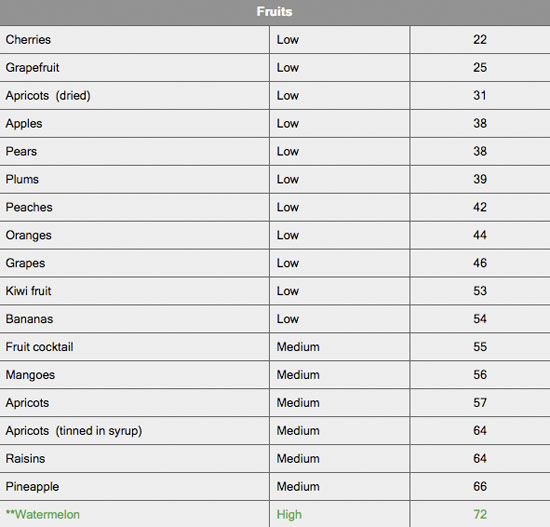 |
| skinnychef.com |
Feb 1, 2011
Simple Kitchari Indian
1 c. basmati rice
1/2 c. mung beans (or other type of legumes such as lentils)
2 T whey or yogurt
2 1/2 c. water (plus whatever you use to soak the dry beans beforehand)
1-2 onions
2-4 T coconut oil or ghee
1 T turmeric
1 T coriander
1 T cumin
1/2 t. ground pepper
1 t. salt (or to taste)
1. Begin by looking over the mung beans for any stones or other debris. Once they have passed inspection, soak the mung beans overnight or in advance with the whey or yogurt and some water.
2. When you are ready to start cooking, strain the beans and rinse them well along with the rice.
Place the rinsed rice and beans in a pot with 2 and a 1/2 cups of water.
Heat on high until it starts to boil. Reduce heat to low and continue to let it simmer for 30 minutes.
3. Ten minutes before the rice and beans are finished cooking, heat coconut oil or ghee in a large pan. Add the chopped onions to the warmed oil and saute until they become translucent.
4. Add the spices and saute for about 30 seconds or until you start smelling the spices.
5. Add the cooked rice and mung beans mixture and combine the two together well.
*from *learningherbs.com
**They say this dish is a simple and typical home-y dish made in India (the same popularity as chicken soup is for us in America). I used a can of kidney beans, and onion powder (since I was limited to what I had on hand). But it tasted like a nice, simple Indian meal. We ate with warm tortillas to rip off pieces and scoop the rice onto with our fingers (the only way to eat Indian food like this). :)
1/2 c. mung beans (or other type of legumes such as lentils)
2 T whey or yogurt
2 1/2 c. water (plus whatever you use to soak the dry beans beforehand)
1-2 onions
2-4 T coconut oil or ghee
1 T turmeric
1 T coriander
1 T cumin
1/2 t. ground pepper
1 t. salt (or to taste)
1. Begin by looking over the mung beans for any stones or other debris. Once they have passed inspection, soak the mung beans overnight or in advance with the whey or yogurt and some water.
2. When you are ready to start cooking, strain the beans and rinse them well along with the rice.
Place the rinsed rice and beans in a pot with 2 and a 1/2 cups of water.
Heat on high until it starts to boil. Reduce heat to low and continue to let it simmer for 30 minutes.
3. Ten minutes before the rice and beans are finished cooking, heat coconut oil or ghee in a large pan. Add the chopped onions to the warmed oil and saute until they become translucent.
4. Add the spices and saute for about 30 seconds or until you start smelling the spices.
5. Add the cooked rice and mung beans mixture and combine the two together well.
*from *learningherbs.com
**They say this dish is a simple and typical home-y dish made in India (the same popularity as chicken soup is for us in America). I used a can of kidney beans, and onion powder (since I was limited to what I had on hand). But it tasted like a nice, simple Indian meal. We ate with warm tortillas to rip off pieces and scoop the rice onto with our fingers (the only way to eat Indian food like this). :)
Subscribe to:
Posts (Atom)